Wednesday, 9 January 2013

Exercise books


Around Christmas time I made three books for the boyfriend’s siblings. I was looking forward to making them because it would mean I could customise and personalise them.

I first used this technique in art at 6th form, on my project ‘derelict structures.’ I used PVA glue and chalk to create an effect which I hoped would replicate the look and feel of old metal and rust. Here is an example of  the technique on other books.

I knew pretty much as soon as I had seen the Mockingjay pin used for The Hunger Games that I wanted it on a book. I printed out a template I found online and transferred it to a piece of cardboard. It was hard work cutting it out. I realised halfway through that it would be easier to cut out a rough shape out of the thick grey board and add in the finer details later.

I had prepared the boards for the covers earlier and it was just the case of sticking the shape onto the front once I had measured its placement accurately.

Making the book block – the pages – was super easy. I took apart two exercise books (the type used in schools) and sewed them together using a simple stitch. This book is only a ‘single section’ binding and is not as complicated as other sewing techniques, which meant I could be precise and neater than usual.

For the Mockingjay book I used black book cloth, which I also used on the N7 book, and for the dragon, green.

For all of the books I started colouring by gluing out where the symbol lay underneath the cloth and adding an initial layer of chalk dust and then building up on this bit by bit by adding more glue in more layers. To achieve this effect I took some chalk and an old scalpel, and scraped away at the chalk to form a dust.

Layer by layer I built up the colours and shading. Once happy I added the details I could not with the cutting of the shape with watercolour pencil and sometimes ink. Finally, I used fixative spray to seal it all.


I think this technique has worked quite well on all three books – I’m most happy with the N7 book - which I like to imagine is a standard issue notebook given to Shepherd on-board the Normandy in the Mass Effect series. Instead of using chalk dust for the red strip, I used red book cloth. The white parts are still chalk dust – I used masking tape to achieve the straight edge.

The only problems I had with the books were the ‘casing in’   - that is, sticking the pages to the cover. I always have trouble at this stage and it doesn’t help that the glue I have dries extremely quickly. There were a couple of mistakes that I hope will go unnoticed.

I am not all happy with the arrow of the Mockingjay. On hindsight I would have left it out completely, as I had not included it initially because it would be difficult to cut out with making a mistake.

But everybody seemed happy with their books. I wonder what they’ll be used for? 


Wednesday, 26 September 2012

Film Book

I have the habit of collecting cinema tickets, and they looked quite tackly on my wall and wardrobe. So I decided I wanted to do something with them.

I made a book, with softer covers than usual as well as a little room on the spine to allow for thickness and flexibilitiy - the soft covers mean I can bend the covers back and write with ease.

On every page I will stick in the cinema ticket and write a reiview of what I remember of the film.

Here's what I have so far.


Tuesday, 25 September 2012

Paignton's Well Read


Paignton – a bustling, touristy sea-side town, resplendent with arcades and charity shops. Paignton offers to a tourist every part of what a British holiday should be, including sticky rock and postcards. It also offers to those holiday makers who want to escape from their holiday escape, in the form of three bookshops in which are contained hundreds of journeys to embark upon.


Of the three, Parkside Books is most ideally situated right among the arcades. On your way to Lidl you may pop into Parkside and pick up value books, too. ‘Budget Fiction’ a sign proclaims in the window. This shop does exactly what it says on the tin.


Our second bookshop is perhaps not so perfectly situated but draws in booklovers regardless. Flying the flag for independent bookshops, The Torbay Bookshop was busy as I stepped in. Colourful, personable and welcoming, the bookshop offers the unique advice-over-the-counter with friendly staff that is so hard to find in big chain bookshops. That, and the shelves are continually updated. The shop has a clear layout and offers, as any good bookshop should, a book ordering service from reliable and nifty resources. It is efficient and yet holds a lot more personality than some other shops out there. And what about the book signings and other literature based events? The Torbay Bookshop is rather brilliant. Why not enjoy a Thornton’s coffee whist contemplating a possible purchase?


Readers may have noticed a distinct lack of bookshops of the second-hand variety in Paignton. Not to fear! Situated close to The Torbay Bookshops lies your redemption. Epicentre has a distinct hand-made quality to it, and you would be excused of thinking, as you step in, that this was somebody’s living room. Deep, comfortable sofas entice readers to perch in bliss and contemplate the vast array of books on the walls. Books surround every surface and they all seem hand-picked. It has books whose condition makes it seem unread, practically new: and it has those delicious old books that mark this shop from the rest. You may notice that a coffee machine lies behind a homely counter, and that there is a menu offering delectable dishes at moderate prices. Epicentre is a gem of Paignton, offering creative workshops and a variety of good quality books. Doubly satisfying, is you are a vegetarian, for there is no mention of meat anyway on the menus.


All good things come in threes, someone once may have or may have not said. The bookshops in Paignton cater to every kind of book browser, including vegetarians and chocoholics. It offers the best of books, in a variety of different shops, and it is a town that is very definitely well read.


Epicentre

Sunday, 9 September 2012

Dartmouth Community Bookshop


I remember seeing the Harbour Bookshop swathed in scaffolding, and my heart plummeted. This bookshop of literary significance had just become another victim to the decline of independent bookshops. Goodness knows what terror may spring up in its place.
      
But, a beacon in the dark: hand written signs, pointing up the dank and narrow alleyway running alongside the late bookshop, proclaiming books could be found.
      
Emerging from the alleyway into a pretty street, the sun shone relentlessly onto a bright and bustling, paint-fresh bookshop.
     
 It wasn’t just the warmth of the sun that comforted me after such a blow. I knew, stepping into the shop, that here was a project I wish would exist in every town. Condensed into a small shop were books, smelling factory fresh, delicately chosen to sit proudly on the shelves.
     
 Dartmouth Community Bookshop’s Facebook page proclaims its simple aim – to retain the tradition of a book lover visiting a bookshop; of the encounters with books that can’t be found anywhere else, especially not on the internet. It also outlined the importance of staff and customer relationships, the advice and guidance from the expansive knowledge of the staff.
      
With the increase of buying on the internet, Dartmouth Community Bookshop stands as a beacon for the magical aura and unique experience of independent bookshops.
      
After the shock of Harbour Bookshop’s untimely death, Dartmouth was left without a bookshop from which the most avid readers could keep up with new and popular publications. The community rallied and were supported by similar projects. Shelf by shelf and person by person the community built a shop that stands proudly within Dartmouth, and retains the important literary links with the town and its people, providing Dartmouth with great and new delights for the entire town to devour.
     
 I took away with me four Book Time magazines and a warm feeling in my heart. There are people out there determined to keep the light burning brightly for independent bookshops, and the importance of loving books. It truly is a place to remember how books can delight not only a book lover, but a whole community.

Dartmouth Community Bookshop
12 Higher Street
Dartmouth
Torbay

Thursday, 23 August 2012

Castle Road and the Highstreet, Totnes


I continue my journey in Totnes. Here I review two more bookshops.


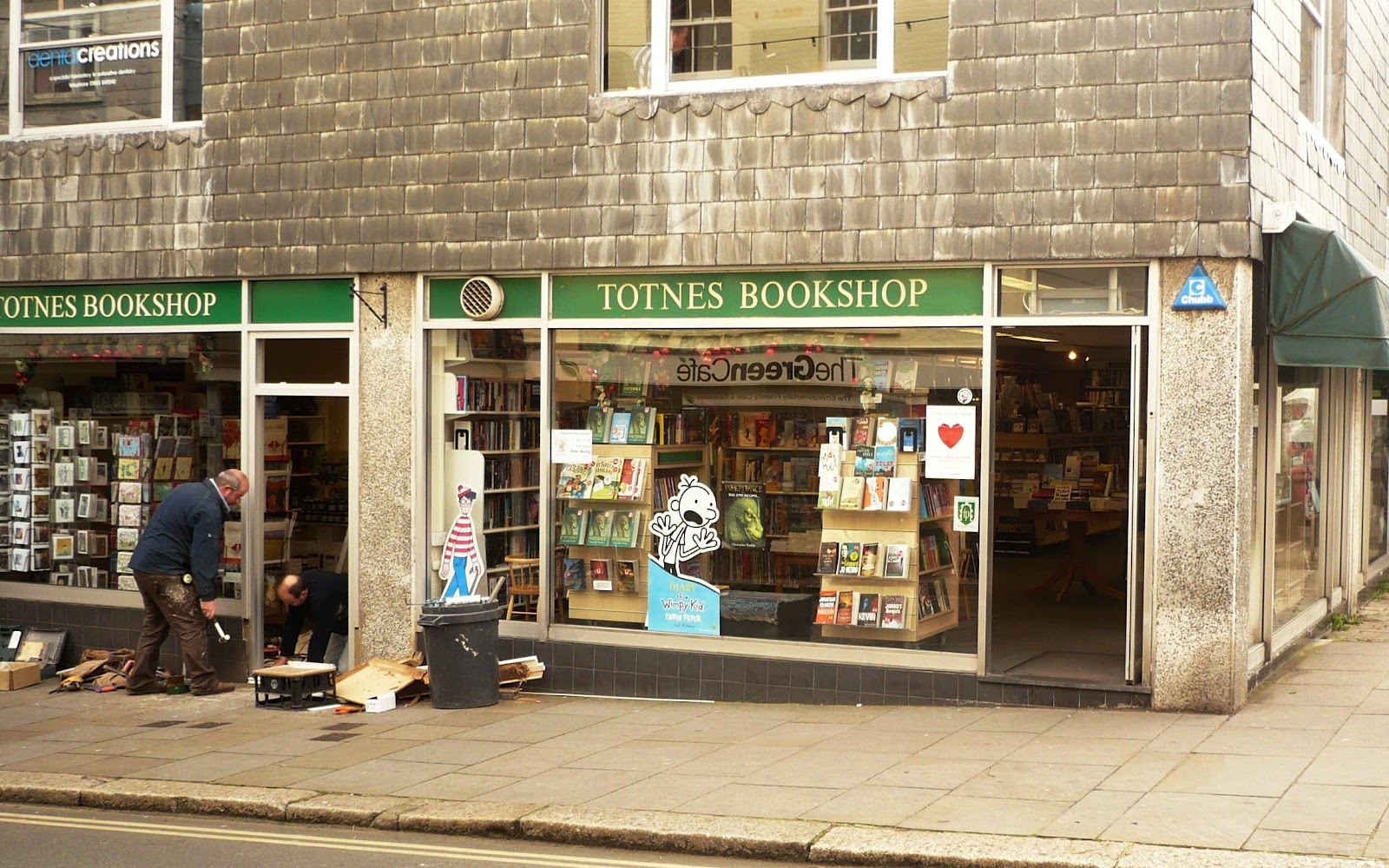
Totnes is incredibly lucky in the way that a reasonably small town, filled with some great history, is graced by three bookshops, two of which are second-hand. If you fancy a bargain, or perhaps a more battered and hard to find copy of a book, Harlequin is perfect: and if you want to be engulfed in the shiny, just out of the packet feel of new books, Totnes Bookshop is the one for you. The small bookshop down Castle Road is cosy and welcoming: imbued with the knowledge of its owner. 

 In Totnes two bookshops straddle the high street and grimace at each other: Harlequin Books, full of tatty old Penguins, and shelves marked ‘Collectable and Unaffordable,’ and Harlequin Books’ younger and more attractive cousin, the Totnes Bookshop.


Independents like Totnes Bookshop are ideal for all your book news, and help is at hand with the knowledgeable and diplomatic staff. The shop covers a wide range of subjects, and as I said, keeps up to date with new releases. Apart from books it sells picture frames, scented candles: a whole paraphernalia of stuff that seem to be picked out for the reader: these objects would be perfect next to a comfy armchair, your reading chair next to a shelf of books.


Totnes’ other second hand bookshop offering is the quaint bookshop found on Castle Road, just round the corner from the others. If Harlequin was middle aged and hippy and Totnes Bookshop young and hip, this bookshop is the younger’s old and mysterious, yet welcoming, aunty. Bravely displaying books on its narrow windowsill, it provides that intimate and friendly atmosphere that is akin to stepping inside the living room of your grandmother. Rugs 
  and wooden chairs aplenty, shelves bursting with old books, this is a place to browse in depth. Separated into two rooms one cannot help but feel that you are surrounded by books, and that any doors or staircases to the rest of the building are obliterated by books that seem carefully selected, that have the privilege of existing in this Aladdin’s Cave. It is a brilliant shop, with an exclusive selection.


Here ends my exploration of the bookshops of Totnes. Fiercely proud of the lack of chain stores and big brands, this town has something for everyone, and caters extremely well to the needs of the public.

Tuesday, 17 July 2012

Harlequin Books, Totnes


Harlequin Books offers the opportunity for browsers to spend all day digging among their stock or even a quick visit to pick up something to read on a lazy summer’s day.


I have discovered recently that I love Devon. This may be because I know a certain someone there, and because we went on lots of boating holidays around there too. I also love Devon because it has some of the best bookshops.

We headed out to Totnes on a grey day in November, when everybody was just about getting used to the idea of autumn and winter that lay beyond. I had looked online before and Totnes was just like every other Devonshire town – it yielded up three bookshops upon a silver platter. There are three bookshops in Totnes, not counting the Oxfam bookshop (where, it has to be noted, I picked up Douglas Cockerell’s Bookbinding) and the wonderful charity shops. One is an independent, one is a small and cosy second-hand, and one is Harlequin Books.

The people at Harlequin have crowded books into every available space, which is probably my favourite kind of set up. Books spilled from the shelves, all tumbled, all in some messy order. Amusing labels accompanied your shopping experience – something like ‘Expensive and Old’ was attached to a shelf containing some first editions of a variety of books.

                The range of books is both fantastic and very easy to get lost in. At the front of the shop, if the outside stalls – harking back to Victorian time bookshops – don’t tempt you inside, then the selection of books within will. Heading the front of the shop is the entire range of Wordsworth Classics, providing an inexpensive but quality edition of what seems to be every known British classic. Other such books adorned the shelves nearby.  They attract a browser to dig deeper into the shop. The contrast of new and old doesn’t clash here, either – it is like the new books are complimenting the old, and the collection within the shop is diverse.

Some particularly nice children’s books sat upon some shelves with a teddy bear: and next to them, a brilliant case of orange Penguins. There is something so satisfying about seeing lots of those titles altogether, something desirable and antique, as well. As far as I can remember, everything was reasonably priced.

I got distracted for a while by digging into a huge pile of old National Geographic. I was hoping that a cover or a title of an article would jump out at me as a potential Christmas present for my brother. Nothing was forthcoming, and my attention went back to a book I had seen on the ‘Expensive and Old’ shelf.

The variety here was delightful, and the atmosphere perfect for any book lover.

........................................................................................................................................................

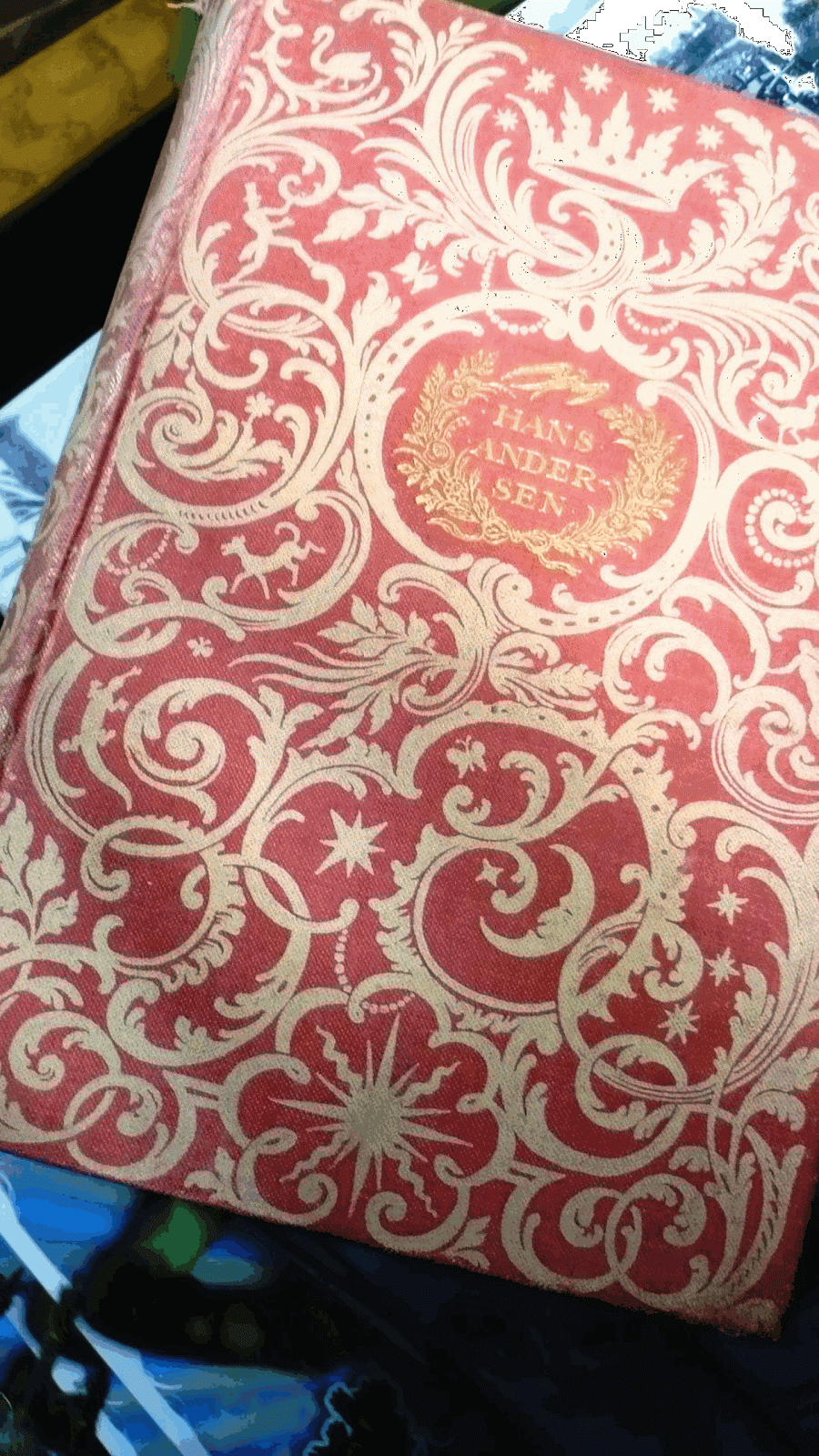
It was a large book of Hans Christian Anderson’s fairy tales that caught my eye. As you may already know from reading this blog, I go pretty gaga over books of fairy tales. I was immediately entranced by the beautiful cover design, and then the age – although not as old as some of the books I own, this was from the 1920s. I like to imagine a previous owner of such a book, and holding it, it filled me with sweet and warm images of children being read to at night, by candlelight: or a child camping under the covers with a torch.

Apprehensively, I opened the book. It was £25. I couldn’t really afford to spend that much money.  

........................................................................................................................................................

David and I visited Harlequin Books again in April. Nothing much had changed, except I noticed that the Hans Christian Anderson book had gone. I would have been prepared to buy it, if it had been there still.

Curiously, David seemed ever so interested in the not-so-interesting sale books that were gracing the outside stalls that he didn’t come into the shop at all.

........................................................................................................................................................

It was reasonably bright for my birthday in May. I had not received any books as yet. David’s presents looked promising. There was a pretty heavy book-looking one among the others.

Tearing into the paper I recognised a pattern that I had fallen in love with. The Hans Christian Anderson Book fell into my hands.

It turned out that it was David who had bought the book just a few days before our visit, and he didn’t want to back into the shop in case the owner sad, ‘How’s the book?’ and therefore ruining a lovely surprise.

........................................................................................................................................................

It sits proudly next to Andrew Lang and Grimm. My collection of fairy tales is growing, and this book is a beautiful companion within my ever-increasing collection of Crumblers.