Saturday, 26 March 2011

A simple way to re-attach a cover

Constructive procrastination  - Write a tutorial

My my, it’s been for EVER since I’ve written a post, I sincerely apologise. I was thinking about reviewing Miss Pettigrew Lives for a Day, but something else far more exciting has come to mind. Recently, my brother’s Moleskine notebook fell apart, (sad face) and he asked me how to repair it. I took some pictures to show him, so I may as well show everyone, too!

How to repair a book that has fallen out of it’s cover

You will need:
·         PVA glue
·         Something to spread the glue with, like a paintbrush
·         Scissors
·         A pencil
·         Strong paper, of a similar colour of the paper of the book’s pages (In my tutorial I’ve used blue to make it easier)
·         2 sheets of shiny magazine paper
·         A spoon
·         Some heavy books


Oh noes! My book has fallen out of its cover. This is a very sad occasion indeed. But it’s okay, we can fix it!
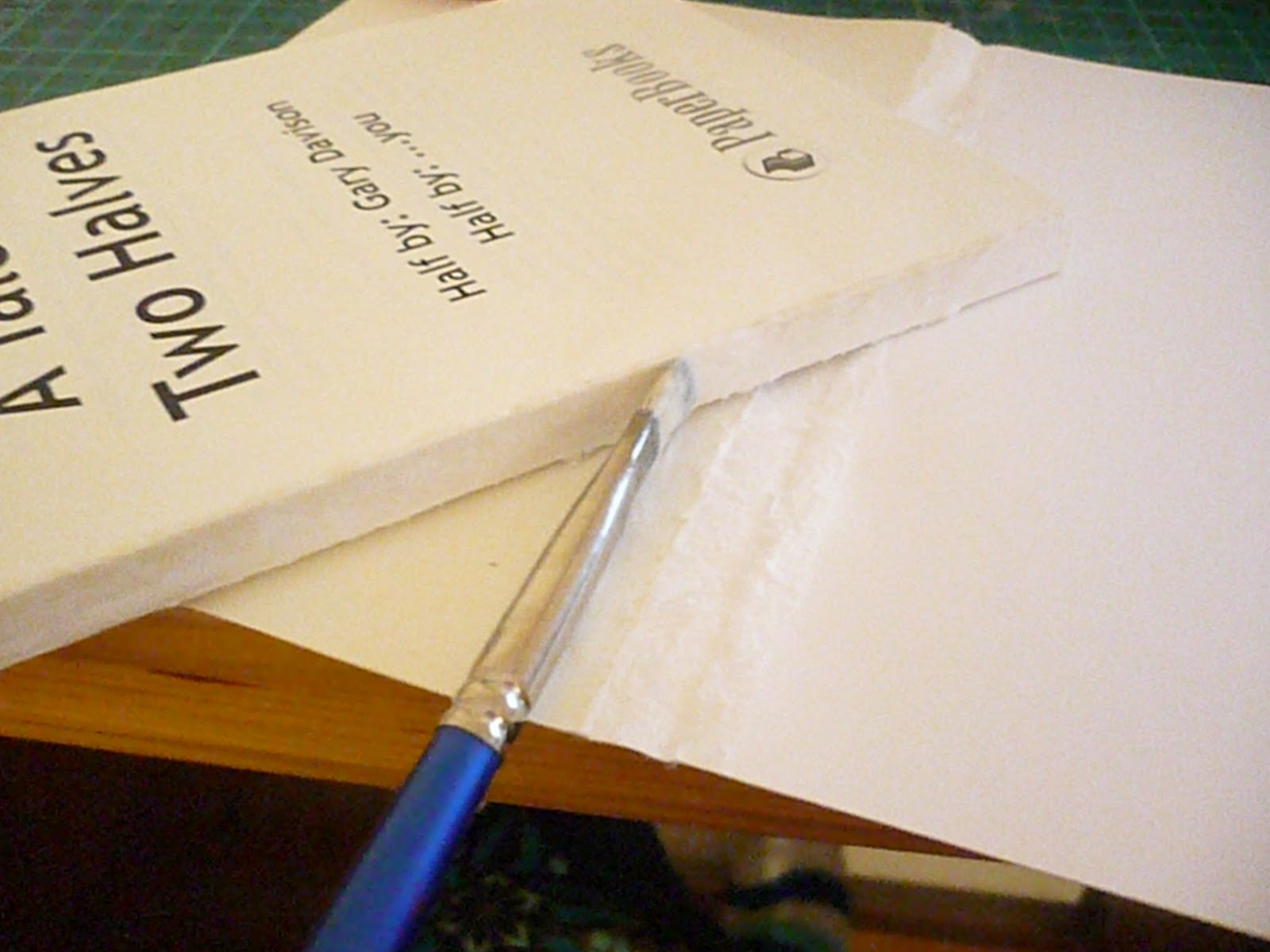


 First, we need to re-strengthen the spine. Just out a thin layer of PVA glue along the spine. If necessary, measure out the dimensions of the spine and cut out a strip of paper to glue to the spine. This process actually happens within bookbinding itself, and with older volumes, you’ll often see other paper glued on the spine, much like this


Next, get your piece of strong paper. I’ve used blue so you can tell what I’m doing. If your first page has a lot of writing on it, you may want to take a picture - you can re-write whatever was on it, because unfortunately some of the page will be covered. Draw around your book and cut out the rectangle.


 Cut this in half lengthways, and fold each half in half, and use a spoon to make the fold nice and crisp. 


Glue one side of the folded strips with a thin layer of glue.


This section can be quite fiddly. Carefully align the strip, with fold aligning the spine, on the book block (the book without it’s cover) With your spoon, really sharpen up the fold, and press down on the area which you have glued, making sure you get rid of any air bubbles.


Repeat on the other side. Hey, it looks like your book has wings!


Next, fold the cover around the book block as if you are covering it again. Carefully lay it down on a flat worktop, making sure to keep the cover and book block aligned. Carefully unfold the cover back. Insert your shiny sheet of magazine paper in-between the ‘wing’. You need to use shiny magazine paper because it won’t stick so badly and will be easier to handle. Use a thin layer of glue on the ‘wing’. Keep the magazine paper within the folds. 


Close the book, pressing down with your spoon on the cover, again making sure you press out all the air bubbles. 


As you can see, I’ve written on the blur paper where the words on the page were covered up.


Leave the book to dry for a while under a heavy weight of books.


Ta-da! Just a simple book repair for any books that fall apart.


Spring is finally here and spring means daffodils. I've been to the lake at uni twice now to pick some. they are so pretty! 


Thursday, 24 February 2011

A Day of Books in Bristol

Seeing as my assessment for one of my modules is mind-numbingly not going well, I think a post is due – it could be called ‘constructive procrastination’.

On Tuesday my fellow bibliofreak Moonstruck and I went to UWE to see an exhibition of Artist’s Books. When we eventually found the university bus and failed to pretend to be UWE students, we capered down the corridors of the Bower Ashton Campus – stylishly arty. We delighted at the signs on the doors – they said things like ‘Print Room’ and ‘Print Room Manager’ on them. We eventually wrestled our way into the library and the very nice man at the desk showed us where the artist’s books were displayed.

Unfortunately the artist’s books were backhanded into empty shelf spaces in the centre of the library near the photocopiers and in the silent study room. I say the books were worth a whole exhibition space!

-->
The first artist book to clamour into view was a display box of a big book of nature, and sprouting from it a branch, with hundreds of individually cut out shapes of beetles swarming over it. I dread to think how long this took!


-->


Then there were slick display cases around the walls that held many delightful little books. Here are a few.

Norway Knits


There seemed to be a lot of city themed books, and I particularly liked this one, very clever idea!


On the windowsill there were some more, and it was a delight to handle them all, especially this really old-looking one, which of course I absolutely loved. A lot of these books had been adpated from old books.


-->


This has got to be my absoloute favourite artits book of the exhibiton - made from A Room of One's Own and Agnes Grey, this actually left us gobsmacked. 


That's right....knitted books! The most genius idea in the history of life!

The only thing about this exhibition....I kinda wish there was somebody there to guide us through it, and I wish we could have spoken to the artist who knitted the books. Simply amazing!

-->
After the exhibition we made our way into the city centre. I’ve never been to Bristol before so the whole concept was quite exciting. I’m not sure hoe I feel about the city. There’s lots of really nice old looking buildings, great bombed out churches (which we took lots of pictures of!) and little streets that would be a delight to explore. I suppose I’m pretty biased nowadays from living in Bath. Nothing’s compared to it so far!

On our hunt for a bookshop we walked down a small ally and encountered one of those shops that have a small exhibition space for local artists. I love discovering exhibitions, it’s great fun!  The guy exhibiting that day, Tim Ulewicz, has an amazing drawing skill and draws, among other things, a lot of mice. We really had a good chat about his work and his collaborations and it was all rather fabulous. I loved loved loved the mouse drawings! Check out his website!

-->


The shop the exhibition was attached to was called SHOP and it’s a delightful vintage-arts venue. Moonstruck bought a hat which she loves! I was tempted by the vintage postcards and fluorescent knits.


-->
link
After being directed to Waterstone’s we asked for directions to a second-hand bookstore. The guy is Waterstone’s was particularly friendly and directed us to ‘Beware of the Leopard’ – a fantastically sprawling book store. There were hundreds of books in the corridor linking the two ‘shops’ that for just a pound. I brought a book of Old English language, it’s from the 1930s, and obviously an old text book, as there are about five different streams of handwriting and doodles throughout. Gorgeously old language, Moonstruck and I had great fun trying to translate it on the train home.


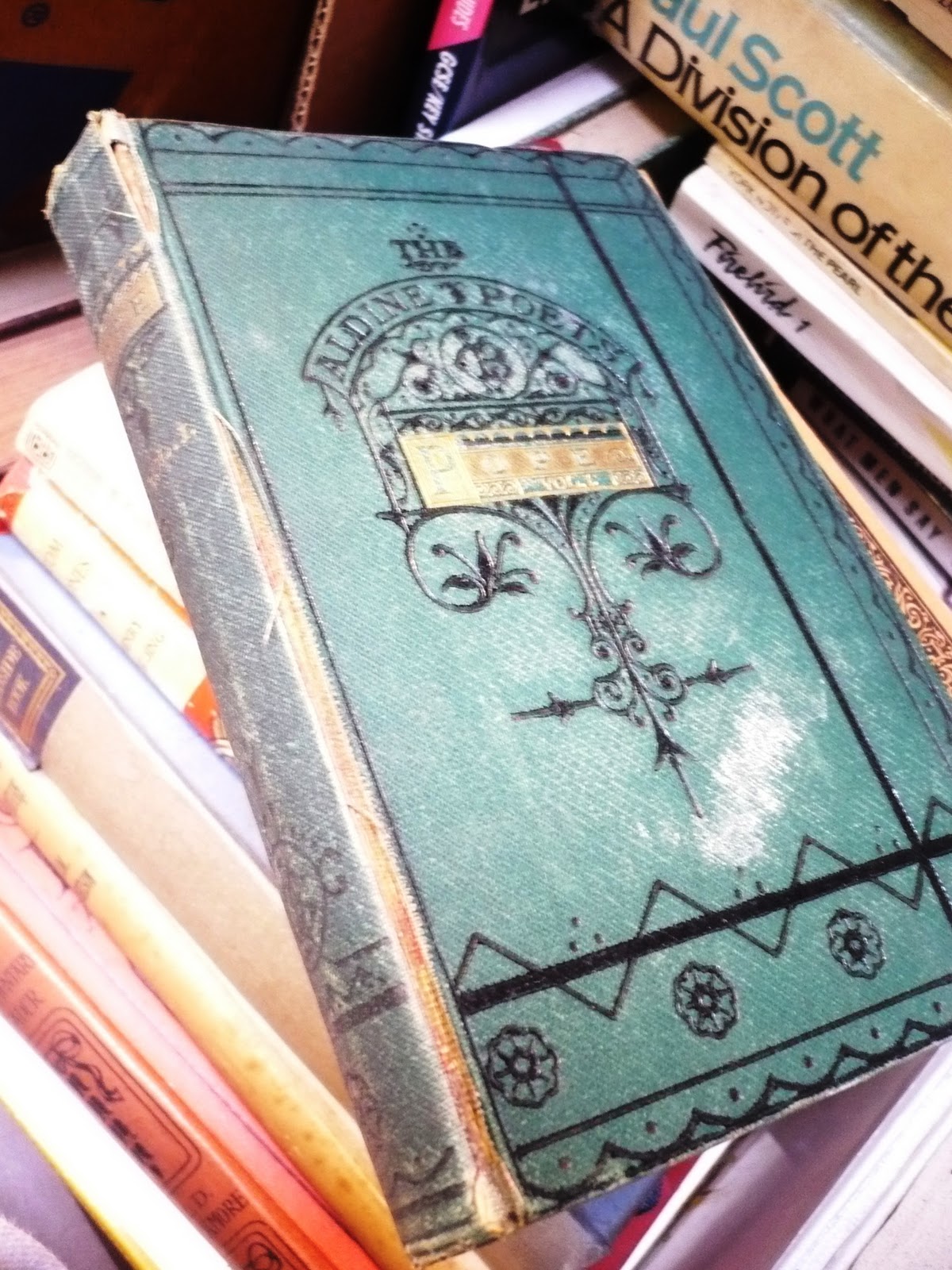
I’m also afraid to say I spent £15 on a book about bookbinding. Oh dear. And I didn't buy this book but I thought the cover was pretty amazing.

Overall it was a pretty incredible arty day in Bristol, I would to spend hours and hours at Beware of the Leopard.

Book arts is a fascinating subject but I feel I want to go more towards the history of the book, though it would be amazing to learn how to do all of these things.


A Book a Week update: I'm afraid to say that it took me two weeks to read The Satanic Verses, mainly because I didn't like it, although I loved the section 'Ayesha'. I'll probably review it at some point.

Currently Reading: Miss Pettigrew Lives For A Day. I love, love, love it.


Friday, 18 February 2011

The Magic 7


My fellow Brockly knit happens has awarded me with a Stylish Blogger Award! This is indeed very exciting. When one receives a Stylish Blogger Award one must give seven facts about themselves, seven facts that a reader might not necessarily know...

My character in Morrowind - Solethe Sunspy.
1.       I am a computer games addict. Fable 3, Morrowind, Oblivion, Pokémon, Sims 2. The best games. And I’ve completed Morrowind/Oblivion so many times I can’t count. And in Morrowind I always meticulously decorate my houses with the objects I have found. I am a geek.
2.      I have a particular fondness for chocolate spread on digestive biscuits. Why not just buy chocolate digestive biscuits you may say. No. No, lazy person. Chocolate spread on digestive biscuits is a gorgeous combination, especially if you add raspberries on top. Gee, it’s making my mouth water.
3.      When I was little my best friends and I buried a ‘time capsule’ under a bush in my garden – the capsule itself was this wicker box thing and we included in it a leaf, a letter, and a worm.
4.      I have a Spiderman fleece on my bed and a Spiderman poster at home and a Spiderman pillow and a Spiderman bowl.
5.      When I tried to drive my dad’s fishing boat I drove it in circles. When I was much younger and my brother was driving the boat I asked, ‘But...doesn’t he need a driving licence?’
6.      I am terrified of all the end-of-the-world predictions and have reoccurring dreams that the world will flood. In one dream the HMS Victory came out of port in full regalia with some survivors on board.
7.      I love aquariums. Especially Plymouth Aquarium. Weymouth Sea-Life Centre is grand, too. Oh, and Fort Victoria. Ha.

Right, now I have given my facts, it is time to give out my awards. Because I don’t have many followers, boo, I’m going to re-send the Award to some people, but they don’t have to reveal a further seven facts, but it could be fun ;) and after that, I’m going to write down who I would like to receive an award.

Dagoth Ur looking positively old computer graphicked.
1 – My fellow Brockly knit happens, who gave me the award
2 – Marvellous Moonstruck, whose seven facts were totally great.
3 – Mystery white girl – who always comes up with fascinating things
4 – Amber Maren Johnson –because she is very interesting!
5 – Lee Pace – because I love him like billy-o.
6 – Dagoth Ur – I don’t think your character was explored enough in Morrowind, if I’m honest. Underneath that scary mask headdress thing you might actually be a fascinating person.
7 – If my best friend had a blog I would challenge her to post seven things I didn’t know about her up, seeing as I pretty much know everything already.

Tuesday, 25 January 2011

The Canterbury Tales by Geoffrey Chaucer - a retelling by Peter Ackroyd

link
How much do I love Chaucer? Just a lot.

I first encountered Chaucer at A-Level. We studied the original, un-translated Merchant’s Tale and I can remember being absolutely thrilled by the mastery of words, and the way in which the words have changed over time. Did you know that an medieval word, ‘Wight’, means man?

However, it would take me months to fully translate the entire tales, as much as I would like to. So instead I left that to Peter Ackroyd, who does a marvellous job of it.

He’s transformed poetry into prose which includes dialogue and characters and generally fabulous things. Among my favourite tales are the Squire’s Tale and of course, the Merchant’s Tale, but I liked the one about the hens and also the one of the cuckolded carpenter. Ackroyd totally changes the form but still retains the humour of the original stories. What we have here is a rich book of tales that probably everybody has to read.

At some points, the literal translations can be crude. The ‘c’ word is used several times, for example. But it adds to the bawdy humour of Chaucer and it is really amazing to consider that, if the pilgrimage was real, that no-one spoke out against it! The Canterbury Tales gives a whole new perspective into medieval life and is therefore thoroughly enjoyable.

However, as much as I love Chaucer, I have only given this book three stars. The prose is often repetitive (Ackroyd) and the stories similar – cuckolded husbands are a common theme (Chaucer). I would appreciate the stories more in their original state, but I am too lazy to translate them. One must also keep in mind that these stories were meant to be read out loud, otherwise the whole novelty of the pilgrims telling their stories to the rest would be lost. The book was easy to put down, unfortunately. But I can really appreciate the work that Ackroyd has out into it, and although it feels almost blasphemous to say it, it’s mainly Chaucer’s fault that I found the stories slightly aggravating. Sorry, man. You're still the father of the English Language. Maybe mention dragons next time?


I know, I know, a lot of reviews recently, but tomorrow will be exciting. Bath Central Library is holding a book sale so I’ll be reporting that. Also I have four books to debut as well as plans for The Fiction Project.

Friday, 21 January 2011

The English Patient – Michael Ondaatje


Link
The English Patient flows like Almasy’s unchartered deserts, with bumps and beauty and mystery. It centres around a collection of nations, a small group of survivors, shell-shocked and living in an Italian villa.

Ever strong is the presence of nature – as if no human can escape it. Even the winds have names.

Marvellously structured, The English Patient delves through history and stories are strong. Beautiful and lyrical. A blend of love and memory. The flawless deliverance of the story make it vivid, sacred.

I like it especially because it talks about writing and books and Django Deinhardt.


‘She had come to love these books dressed in their Italian spines, the frontispieces, the tipped-in colour illustrations with a covering of tissue, the smell of them, even the sound of the crack if you opened them too fast, as if breaking some minute unseen series of bones.’ 


Saturday, 15 January 2011

Elder


Hill and hill and scab and scale, the hide that reaches,
gropes for the sun, lean-to, winter death.
Fingers alive caress the contours of bark,
and feel its dryness, cracked,
flaking skin flakes away in hand.
How things have burrowed,
 biting blind,
 revealing ruddy flesh,
 sand-red, moist dripping.
Spurts of white flower in sunlight – spring.
Black bitter things bunch - the year is old, and the tree dies,
bare and corroded, consumed and spent.
This is the tree of life.
This is the tree of death.
Was its beginning placed by hands
or had it already been there?
 Some say it is there as a warning for witches,
a warding of witches,
though fairies crawl
through wood-worm cast to sit in fleshy self.
I sat on it. I sat in a cheating card-board wood house on it,
painting life and plaiting string.
My castle.
A house.  
Insect menagerie, they come and go as they please.
That was when the tree was strong, pre-amputation,
before the earth shifted and set its angle.
In the summer my tree is my water,
I drink what is left of the season. I drink the sun.    
Savour every drop. A year is too long.
In autumn my tree grows berries of pearl black,
 bunches where the white should be, will be.
 In winter the tree is a dead thing.
Wood-worm cast. Exposed and exceptional, my tree.
The tree of life, the tree of death,
witch-ward, wood-wormed, child-play.
 At the bottom of my garden,
garden guarding.
My tree.
My elder tree.